
cleaning
Multi-column
utensils
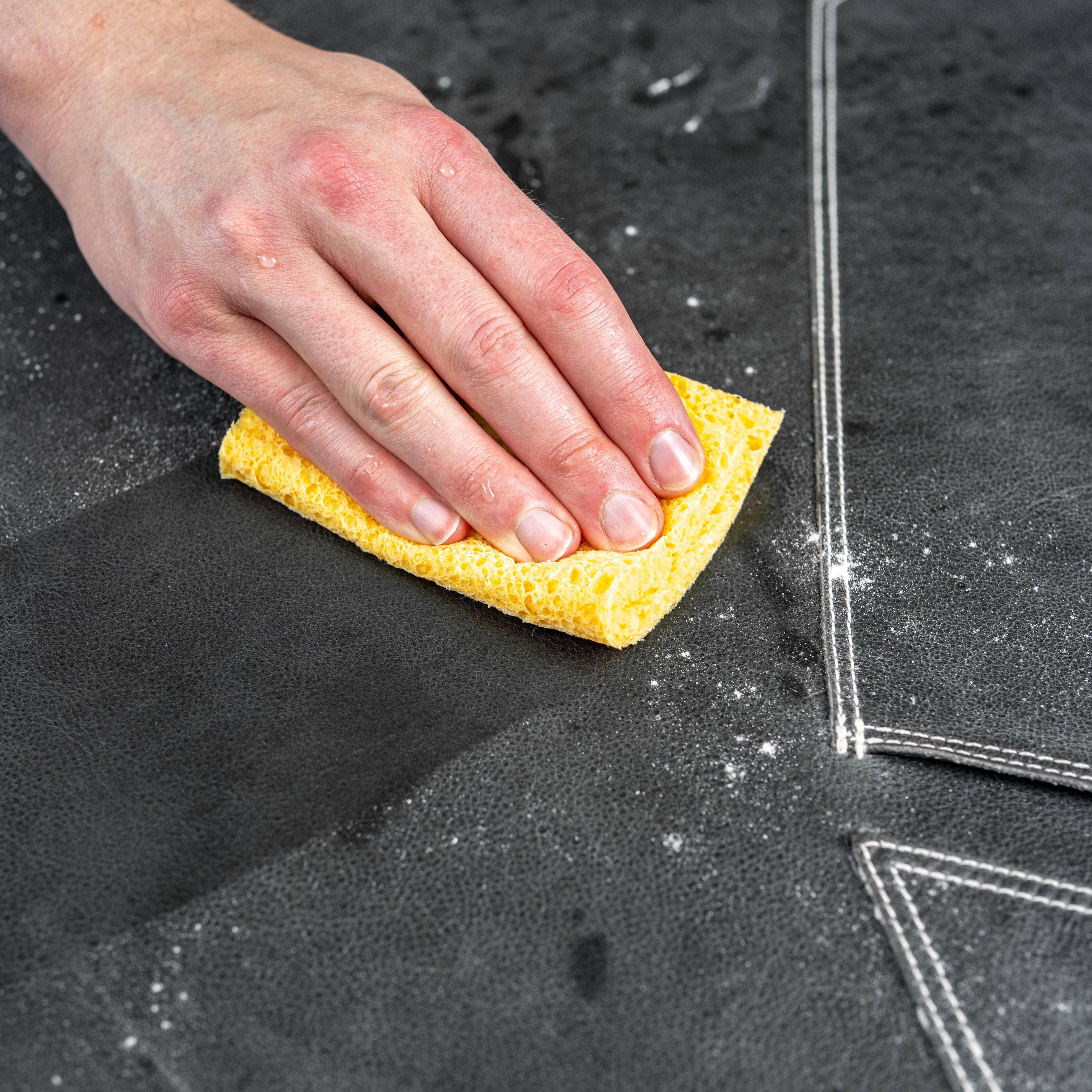
It's best to use a sponge and water for cleaning. Avoid using detergents , as these will damage the leather's surface.
cleaning
Wipe the surface gently. Avoid using abrasive or scratchy sponges, as these can cause damage. Grease stains will disappear over time, so they can be ignored.
Dry
Allow the leather to dry at room temperature. Wet, full-grain leather is delicate and can shrink if exposed to excessive heat—so never dry your product in the oven or on a radiator!
Care
Multi-column
Which leather care?
Leather care products are plentiful. However, be careful not to buy petroleum-based products , as these often contain solvents that can damage the leather over time.
Only natural, plant-based waxes and oils keep your product beautiful for a long time.
use
The leather conditioner is applied with a soft sponge or cloth . Leather conditioner is generally very effective, but as is often the case, more is better.
There is no fixed interval, but once a month or after cleaning is generally recommended.
Apply
For light, superficial scratches, a single coat is usually sufficient to remove them. For completely worn-out areas, a second coat may be necessary.
Massaging it in with your hand increases the effect of concealing scratches.
Smooth
Multi-column
equipment
You'll need an iron , a cloth napkin, a tea towel, or Teflon film (reusable baking foil, etc.), and a flat, preferably soft surface such as an ironing board . If you don't have an ironing board, an old T-shirt on a table will also work.
Preparation
Place the placemat face down on your surface (rough side facing you). Place the cloth or Teflon sheet on top of the placemat .
Preheat the iron to medium heat .
Iron
Move your hands evenly over the cloth or Teflon film. The goal is to press firmly ; the placemat should not warp or move .
This should take as short a time as possible - check again and again whether the desired smoothness has been achieved.
Logo list